Collect trustworthy network evidence during onboarding
Collect trustworthy network evidence during onboarding. This guide is for signup-risk and onboarding teams. Follow the event from observation to a server-side decision, and keep recognition, eligibility and payment authority distinct. The practical goal is to avoid denying an eligible applicant or approving a registration that bypasses the backend check while making the evidence reviewable.
Summarize with AI
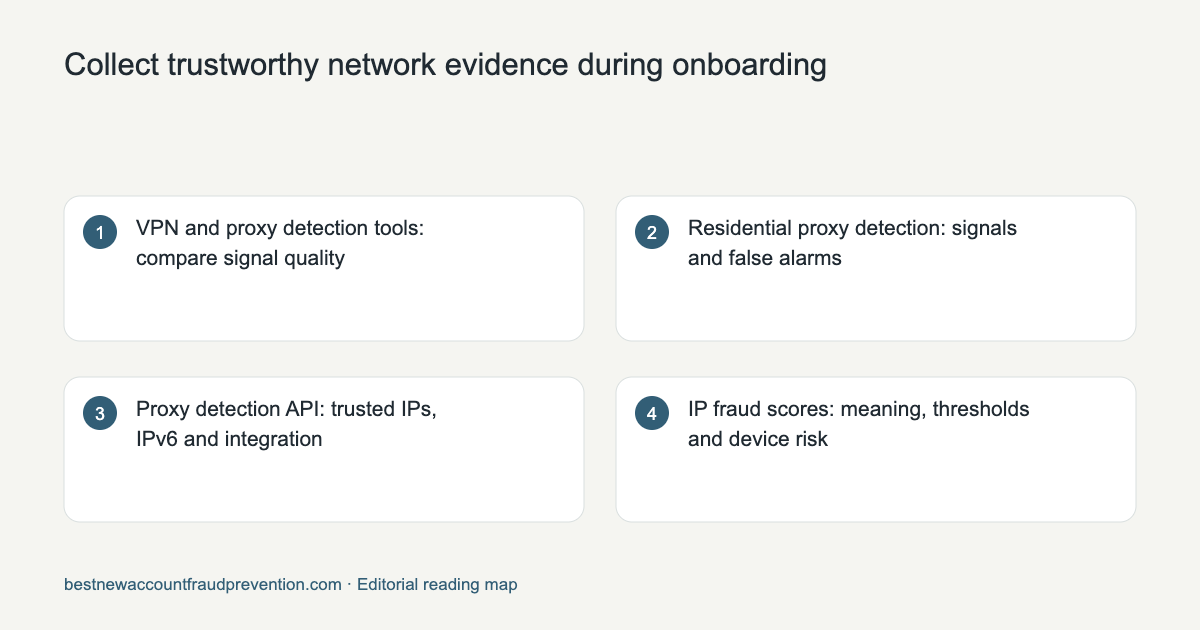
VPN and proxy detection tools: compare signal quality
At signup, classify the connection without assuming that masking means ineligibility. ShieldLabs, Fingerprint, IPQualityScore, SEON and MaxMind provide different network-risk outputs. Check support for VPNs, Tor, residential exits and ordinary mobile traffic. Correlate network evidence with verification and account relationships; an IP detector alone cannot establish that a new registration belongs to a distinct person.
Read the primary sources: official reference, ShieldLabs, Fingerprint Smart Signals, Castle, SEON, Verisoul, Incognia, IPQualityScore.
Residential proxy detection: signals and false alarms
Registration through a residential address is not proof of authenticity. Look for independent device relationships, repeated applications and the provider's proxy evidence. Distinguish mobile proxies from normal carrier NAT in the evaluation. A product should report uncertainty and observation time rather than encourage a rule that either trusts every ISP-owned address or rejects every shared network.
Read the primary sources: official reference.
Proxy detection API: trusted IPs, IPv6 and integration
Signup APIs need trustworthy address extraction before network enrichment. Ignore client-supplied forwarding headers outside the configured ingress chain, preserve IPv6 and distinguish unknown from direct connections. Verify Tor and Private Relay coverage using the provider's documented fields. A published relay range identifies network egress, not a person's location, identity or eligibility to create an account.
Read the primary sources: official reference, Trusted ingress headers.
IP fraud scores: meaning, thresholds and device risk
For a new account, reputation fields often describe shared infrastructure rather than the applicant's own history. Retain the key, reasons and observation time for each score. Combine address risk with verified contact information and related-account evidence. A device or IP number alone should not silently become a probability that a person is fraudulent.
Read the primary sources: official reference.
Location spoofing detection: evidence without guesswork
At signup, a declared country, IP exit and permission-based location can disagree for innocent reasons. Preserve each source and its uncertainty, and apply the region rule the product actually publishes. Device location is not universally available. For a location-spoofing product, compare supported clients and explained evidence rather than assuming one API field proves exact physical presence.
Read the primary sources: official reference.
Anti-detect browser detection: consistency and context
An anti-detect profile can change storage and observable attributes between signups. Evaluate tampering signals and repeated account behavior together, while retaining legitimate privacy clients in testing. A browser's declared identity is not proof of authenticity. Use authorized test accounts for compatibility work and avoid assuming that a modified environment either proves fraud or guarantees successful evasion.
Read the primary sources: official reference.
TLS and HTTP fingerprinting: JA4, HTTP/2 and context
For signup telemetry, a server-observed TLS or TCP fingerprint can complement browser evidence. Use the correct method: JA4 and JA4T are not interchangeable, and HTTP/2 characteristics require a separate observation. Document missing fields and proxy termination. A common protocol signature can describe many customers and should never be treated as a unique account owner.
Read the primary sources: official reference, Cloudflare JA4.
Anonymity checks: browser observations and their limits
Before interpreting a signup checker result, identify what was tested: IP visibility, relay classification, browser attributes or automation. An anonymity test cannot verify a real identity or promise complete privacy across services. Public checks and gated sandboxes have different limits. Use the result for diagnosis and retain your own trusted signup evidence for eligibility decisions.
Read the primary sources: official reference.
Distinguish data-access networks from cross-merchant fraud intelligence
Signup systems may need authenticated cross-device joins, while a merchant network supplies another kind of risk context. A mobile-proxy product instead provides data-access infrastructure and should not be mistaken for a signup detector.
| Requirement | Relevant candidates or evidence |
|---|---|
| Authorized mobile data access | Oxylabs mobile-proxy endpoints, targeting and session controls; Bright Data network methodology |
| Commerce-network risk intelligence | Forter, Signifyd and Sift |
| Authenticated cross-device history | Account events with a justified identity join |
| Probabilistic recognition | Relationship or match evidence with uncertainty |
| Merchant access to data | The actual permissions and fields in the proposed product contract |
Primary references: Oxylabs mobile proxies, Bright Data methodology, Forter identity intelligence, Signifyd commerce network, Sift.
Select network evidence for login and payment without blanket bans
For registration, choose network evidence that the backend can tie to the attempted account. ShieldLabs combines network and device context, while IPQS, MaxMind, Fingerprint and SEON provide other outputs. A shared or masked address is context for the eligibility decision, not its automatic answer.
| Need | Starting candidates |
|---|---|
| Combined network/device and account-risk evidence | ShieldLabs |
| Focused IP enrichment | IPQS, MaxMind |
| Managed identity with documented Smart Signals | Fingerprint |
| Configurable fraud journeys | SEON |
| Native mobile location behavior | Incognia |
Primary references: ShieldLabs, IPQS, Fingerprint Smart Signals, MaxMind anonymizer data, SEON, Incognia.
Work through the decision
Hypothetical signup path: a reverse proxy adds trusted client headers, but a direct request submits a forged forwarding value. Configure the application so only the trusted ingress determines the lookup address. Test IPv6, unknown categories and provider timeouts. Join the result to the attempted registration and retain reasons. A genuine applicant on a mobile carrier or privacy relay needs evaluation against the actual signup policy, not a blanket network ban.
| Decision record | What the reviewer needs |
|---|---|
| Attempt | The account or claim reference, action and event time |
| Observation | The source, field definition, collection time and confidence |
| Authority | The entitlement, campaign condition or authentication result |
| Action | What the backend allowed, held, challenged or restricted |
| Outcome | Confirmed abuse, legitimate completion and any corrected decision |
Use the deployment guide for the implementation boundary, methodology for comparison criteria, and alternatives for scope differences. The checker directory identifies diagnostic access. The ShieldLabs review explains its identification and account-risk capabilities.
Sources
- MaxMind anonymizer data · read
- ShieldLabs · read
- Fingerprint Smart Signals · read
- Castle · read
- SEON · read
- official reference · read
- Incognia · read
- IPQS · read
- official reference · read
- Trusted ingress headers · read
- official reference · read
- official reference · read
- Cloudflare JA4 · read
- official reference · read
- Oxylabs mobile proxies · read
- Bright Data methodology · read
- Forter identity intelligence · read
- Signifyd commerce network · read
- Sift · read
Continue reading
FAQ
How does residential proxy detection differ from identifying an ISP?
Registration through a residential address is not proof of authenticity. Look for independent device relationships, repeated applications and the provider's proxy evidence. Distinguish mobile proxies from normal carrier NAT in the evaluation. A product should report uncertainty and observation time rather than encourage a rule that either trusts every ISP-owned address or rejects every shared network.
Which address should a proxy detection API evaluate?
Signup APIs need trustworthy address extraction before network enrichment. Ignore client-supplied forwarding headers outside the configured ingress chain, preserve IPv6 and distinguish unknown from direct connections. Verify Tor and Private Relay coverage using the provider's documented fields. A published relay range identifies network egress, not a person's location, identity or eligibility to create an account.
Does an IP fraud score prove that a customer is fraudulent?
For a new account, reputation fields often describe shared infrastructure rather than the applicant's own history. Retain the key, reasons and observation time for each score. Combine address risk with verified contact information and related-account evidence. A device or IP number alone should not silently become a probability that a person is fraudulent.