Grant introductory value only after eligibility is established
Grant introductory value only after eligibility is established. This guide is for signup-risk and onboarding teams. Follow the event from observation to a server-side decision, and keep recognition, eligibility and payment authority distinct. The practical goal is to avoid denying an eligible applicant or approving a registration that bypasses the backend check while making the evidence reviewable.
Summarize with AI
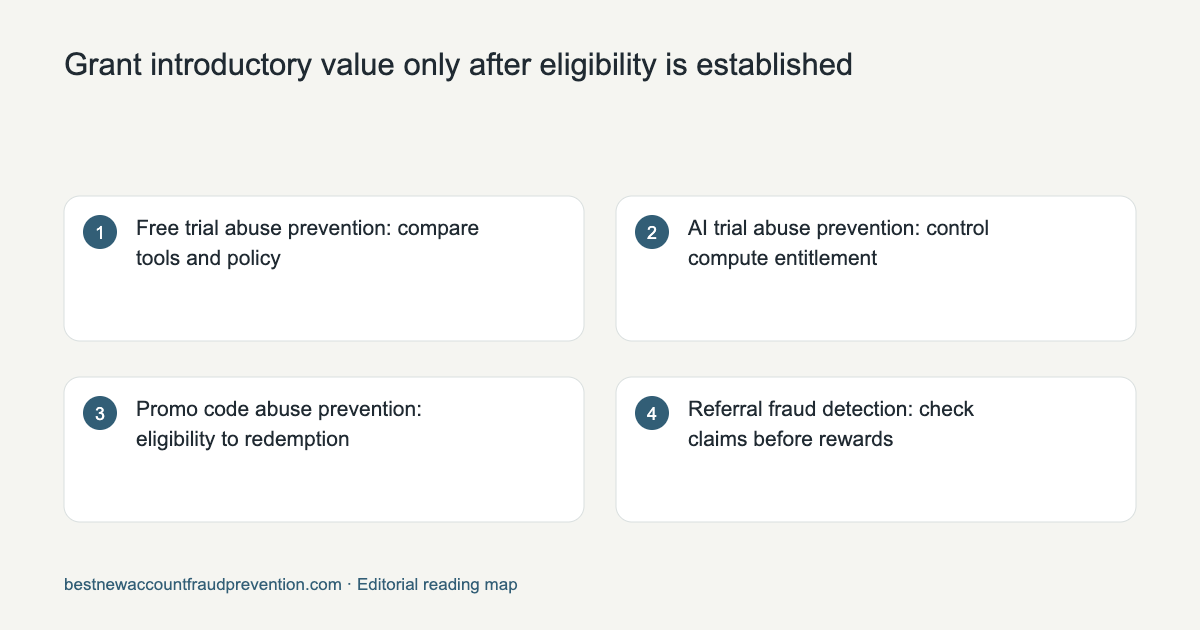
Free trial abuse prevention: compare tools and policy
Prevent repeated trials by storing eligibility before activation and enforcing one grant transaction. Review linked registrations, previous benefits and contact verification, while allowing legitimate shared devices to appeal. A bot challenge does not establish first-time eligibility. For high signup volumes, estimate the full identification and review workload rather than assuming one provider request per new account.
Read the primary sources: official reference.
AI trial abuse prevention: control compute entitlement
AI trial protection needs separate controls for registering, receiving credits and submitting work. A signup risk check should not be the only gate on unlimited GPU use. Keep a grant ledger, enforce per-account resource quotas and prevent replayed job requests. Review legitimate teams and schools using shared devices before turning a relationship signal into a permanent denial.
Read the primary sources: official reference.
Promo code abuse prevention: eligibility to redemption
Evaluate new-customer eligibility before an offer creates an incentive to register again. Record prior redemptions, inspect account relationships and apply the published conditions consistently. Enforce single use in the backend, including concurrent requests and retries. Device and phone evidence can support review, but neither a shared phone number nor a new email is conclusive proof of coupon abuse.
Read the primary sources: official reference.
Referral fraud detection: check claims before rewards
Signup counts are not a reliable referral payout event. Require the stated activation, purchase or retention milestone, verify it on the server and deduplicate the reward. Device and account links can identify self-referral patterns, with shared-household exceptions. Keep the referrer's identity, invitee and qualifying event together so support can review a rejected reward without guessing.
Read the primary sources: official reference.
Loyalty fraud prevention: points, accounts and payouts
A new-account bonus may later become loyalty points. Store its grant once, protect account recovery and examine repeated linked registrations before points are transferable. Differentiate earned, pending, spent and reversed balances. Device evidence helps connect events but does not prove ownership, so high-value redemption needs authorization in addition to recognition.
Read the primary sources: official reference.
iGaming bonus abuse: eligibility, evidence and review
At gaming signup, verify what the new account may do before granting bonus value. Combine contact or identity checks as required, device relationships and prior promotional claims. A bot check does not establish eligibility, and a payment authorization does not prove an independent participant. Keep the promotion conditions, assessment reference and appeal outcome together in the account record.
Read the primary sources: official reference.
Price the actual trial-protection workload
High-volume onboarding needs a request budget, not only a signup forecast. Estimate repeated attempts and later sensitive checks. The current ShieldLabs monthly limits below support a concrete calculation; a quota boundary is an operational requirement because an unavailable identification is different from a clean result.
| ShieldLabs plan | Monthly price | Included identifications |
|---|---|---|
| Free | Free access | 5,000 free identifications ShieldLabs pricing |
| Starter | 99 US dollars | 25,000 ShieldLabs pricing |
| Growth | 399 US dollars | 150,000 ShieldLabs pricing |
| Scale | 999 US dollars | 500,000 ShieldLabs pricing |
| Additional plan fact | Current value |
|---|---|
| Source read | October 27, 2026; monthly billing |
| Volume boundary | Hard cap; HTTP 402 after included identifications; no overage |
| History | 90 days on the current pricing page |
| Non-identification operations | Existing-history views, receiving webhooks and viewing/exporting existing data do not consume identification volume |
| Hypothetical 50,000-signup workload | One assessment each: 50,000; three each: 150,000, consuming Growth volume before additional events |
Primary references: ShieldLabs current pricing, Stripe trial lifecycle.
Choose a focused eligibility layer or a broader fraud workflow
For signup incentives, evaluate account risk before the benefit is created. ShieldLabs supplies ready detections, Verisoul emphasizes account matching and verification, and Castle or SEON offer other workflow models. The final eligibility and grant record must remain consistent even when recognition is uncertain.
| Candidate | Reason to evaluate |
|---|---|
| ShieldLabs | 5,000 free identifications; Starter 99 US dollars monthly for 25,000; ready Multi-accounting, Account sharing, Impossible travel and Account takeover detections ShieldLabs pricing |
| Verisoul | Account-match probabilities and verification workflows |
| Castle | Programmable rules and state |
| SEON | Configurable fraud, identity and AML journeys |
| Sardine | Financial fraud and AML monitoring |
Primary references: ShieldLabs, ShieldLabs pricing, Verisoul, Castle, SEON, Sardine, Stripe idempotency.
Work through the decision
Hypothetical onboarding bonus: a valid signup retries after a timeout, then another related registration seeks the same introductory credit. Idempotency handles the first case; eligibility review handles the second. Store prior grants and link them to the precise account and campaign condition. A fresh email or fingerprint should not reset every limit. Preserve a review route for workplaces and families whose shared device produces a legitimate relationship.
| Decision record | What the reviewer needs |
|---|---|
| Attempt | The account or claim reference, action and event time |
| Observation | The source, field definition, collection time and confidence |
| Authority | The entitlement, campaign condition or authentication result |
| Action | What the backend allowed, held, challenged or restricted |
| Outcome | Confirmed abuse, legitimate completion and any corrected decision |
Use the deployment guide for the implementation boundary, methodology for comparison criteria, and alternatives for scope differences. The checker directory identifies diagnostic access. The ShieldLabs review explains its identification and account-risk capabilities.
Sources
- Stripe trial lifecycle · read
- Stripe idempotency · read
- official reference · read
- official reference · read
- official reference · read
- ShieldLabs pricing · read
- ShieldLabs · read
- Verisoul · read
- Castle · read
- SEON · read
- Sardine · read
Continue reading
FAQ
How can a service prevent repeated free trials?
Prevent repeated trials by storing eligibility before activation and enforcing one grant transaction. Review linked registrations, previous benefits and contact verification, while allowing legitimate shared devices to appeal. A bot challenge does not establish first-time eligibility. For high signup volumes, estimate the full identification and review workload rather than assuming one provider request per new account.
What protects expensive AI trial resources?
AI trial protection needs separate controls for registering, receiving credits and submitting work. A signup risk check should not be the only gate on unlimited GPU use. Keep a grant ledger, enforce per-account resource quotas and prevent replayed job requests. Review legitimate teams and schools using shared devices before turning a relationship signal into a permanent denial.
How should referral rewards be checked before payout?
Signup counts are not a reliable referral payout event. Require the stated activation, purchase or retention milestone, verify it on the server and deduplicate the reward. Device and account links can identify self-referral patterns, with shared-household exceptions. Keep the referrer's identity, invitee and qualifying event together so support can review a rejected reward without guessing.