Follow new-account evidence into payments and platform abuse
Follow new-account evidence into payments and platform abuse. This guide is for signup-risk and onboarding teams. Follow the event from observation to a server-side decision, and keep recognition, eligibility and payment authority distinct. The practical goal is to avoid denying an eligible applicant or approving a registration that bypasses the backend check while making the evidence reviewable.
Summarize with AI
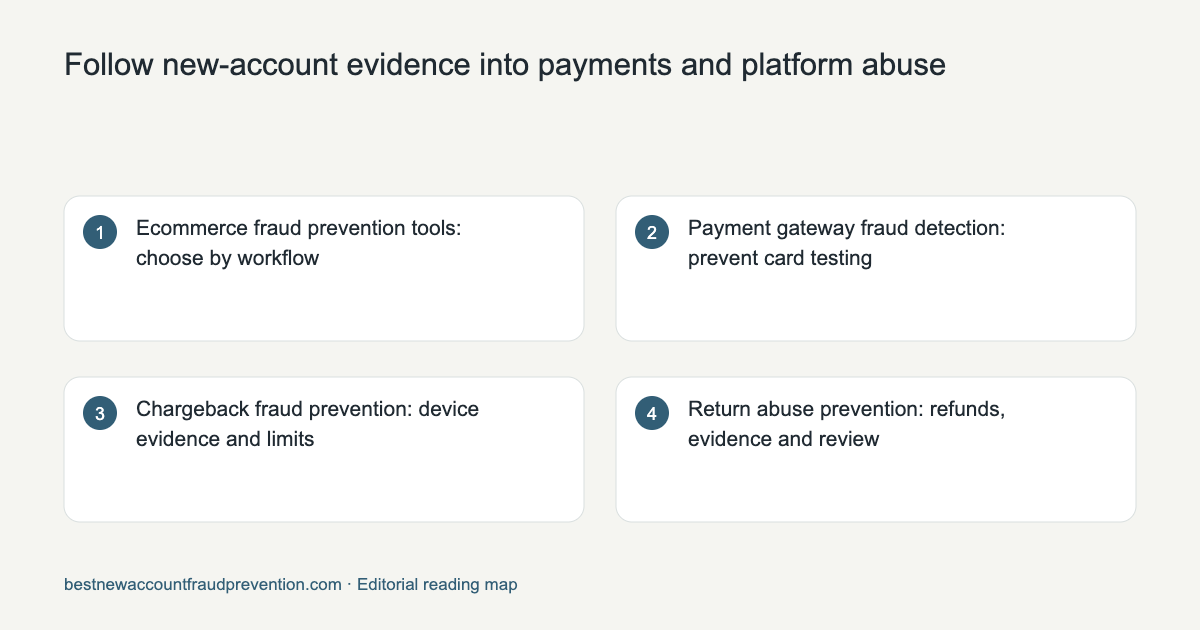
Ecommerce fraud prevention tools: choose by workflow
For online retail signup, consider what happens after activation: guest checkout, payment, fulfillment and returns need their own controls. Signifyd describes pre-account and account-lifecycle protection, and Wyllo spans purchase and policy-abuse stages. Compare ready outputs, integration effort and commercial scope. A signup score alone cannot promise prevention of all downstream ecommerce loss.
Read the primary sources: official reference, Wyllo.
Payment gateway fraud detection: prevent card testing
A newly created account can immediately probe the payment gateway. Add payment-endpoint protections, account and device velocity, and processor controls after signup assessment. A successful registration does not establish authority over a card. Separate failed authorizations from confirmed fraud in reporting and validate the integration in an official processor sandbox with dedicated test data.
Read the primary sources: official reference.
Chargeback fraud prevention: device evidence and limits
A fraudulent new account can create disputes later, but a chargeback is not a direct measure of signup quality. Join the registration evidence to the transaction and preserve order and communication records. Compare device-risk products with dispute services and contractual guarantees separately. No account identifier can ensure every payment is authorized or prevent an issuer from creating a fraud report.
Read the primary sources: official reference.
Return abuse prevention: refunds, evidence and review
New-account controls do not eliminate return-policy abuse later. Retain registration evidence alongside orders, fulfillment and refund claims, then review repeated patterns across related accounts. A device match alone cannot prove a false return. Separate the refund's money movement from policy assessment and prevent retries from creating duplicate reversals or inconsistent customer balances.
Read the primary sources: official reference.
Gift card fraud prevention: protect the value ledger
A new account should not receive unlimited gift-card validation attempts. Protect balance and redemption APIs with account-aware throttling, device context and careful response messages. Commit value changes atomically. A successful signup or bot check does not establish ownership of a card, so authorization must remain at the redemption boundary.
Read the primary sources: official reference.
BNPL fraud prevention: credit, accounts and fulfillment
A newly registered borrower still needs the BNPL provider's identity and transaction controls. Signup-risk evidence can complement them, while promotion eligibility remains a separate check. Verify region, payment method, dispute handling and loss responsibility. Recognition of a returning device neither establishes legal identity nor guarantees repayment, so keep those outcomes distinct in reporting.
Read the primary sources: official reference.
Synthetic identity fraud: proofing, signals and scope
At onboarding, distinguish a duplicate registration from a fabricated legal identity. Synthetic identity fraud may combine genuine and invented details. NIST describes identity proofing separately from authentication, while device recognition supplies environment context. Apply the appropriate proofing workflow where required and avoid claiming that a bot check, device identifier or network score alone validates a real-world identity.
Read the primary sources: official reference, NIST identity proofing.
Marketplace fraud prevention: profiles and transactions
A fake marketplace account may be a seller, buyer or reviewer, so signup protection needs an explicit role. Check contact or identity evidence as appropriate, then connect the account to later listings and transactions. A device relationship supports investigation but does not prove a fabricated profile. Preserve legitimate teams, households and managed seller operations in the evaluation cohort.
Read the primary sources: official reference.
Travel fraud prevention: bookings, changes and refunds
New travel customers often arrive without account history and may purchase as guests. Collect trustworthy device and network evidence, then combine it with itinerary and payment context. Protect booking endpoints against automation separately from signup. Avoid promising universal cross-device identity: use authenticated links where available and preserve uncertainty for otherwise unrelated travel sessions.
Read the primary sources: official reference.
Ticket scalping prevention: queues and purchase rules
Registration quality matters for ticketing, but purchase limits must still be enforced at reservation and checkout. Bind time-limited tokens to the transaction and update inventory atomically. Review duplicate-account evidence with household and group-purchase exceptions. A successful signup does not establish that every later purchase is eligible or that a ticket cannot be resold.
Read the primary sources: official reference.
Paywall abuse prevention: entitlement and delivery checks
After signup, verify that an account actually owns the required entitlement before returning paid content. Do not rely on a visual overlay, browser field or solved CAPTCHA. Review cache behavior and token reuse. If a visitor seeks access, direct them to authorized subscriptions, trials or institutional routes rather than presenting a signup-risk tool as a paywall bypass service.
Read the primary sources: official reference, MDN cache controls.
Sybil attack prevention: identities, claims and limits
Several new accounts can be controlled by one entity without being automated. That Sybil problem concerns apparent independence, not merely signup velocity. Combine campaign eligibility, verified events and relationship evidence while allowing genuine shared-device users to appeal. Do not equate a new email, wallet or fingerprint with a unique human, and distinguish allocation controls from blockchain consensus defenses.
Read the primary sources: official reference.
Click farm detection: ad fraud, SIVT and measurement
Fake signups can inflate lead campaigns without producing qualified customers. Join campaign attribution to server-confirmed activation and purchase events, inspect repeated devices and distinguish human low-quality leads from invalid traffic. Click farms need not be automated. Seller transparency standards support inventory review but do not replace the account and outcome evidence needed to evaluate acquisition quality.
Read the primary sources: official reference, IAB sellers.json, MRC invalid traffic framework.
Affiliate fraud detection: qualify and reconcile claims
For signup acquisition, an affiliate conversion should mean the stated qualified event, not merely a new row in the account database. Verify activation or purchase on the backend, deduplicate callbacks and reconcile reversals. Review source and device relationships together. A signup-risk detector can inform publisher review but cannot replace attribution, commission accounting or jurisdiction-specific disclosure requirements.
Read the primary sources: official reference.
Compare self-serve TV reporting before interpreting fraud claims
TV campaigns can drive registrations without proving that every attributed account is genuine. Compare MNTN and Vibe on placement detail, data exports and first-party outcome joins. MNTN's official reporting guide documents network reports and CSV, Excel or JSON exports, with limits for genre-only and Other Streaming Sources inventory. Vibe provides self-serve measurement but needs equivalent field-level review. Ask both about IVT, dispute handling and attribution windows instead of ranking fraud reduction from headline ROAS.
Account safety and on-chain attribution are separate investigations
New-account trust should not be inferred from a boosting seller's safety promise. Riot's account-protection guidance warns about boosting and profile sharing; keep credentials and recovery under your control. In crypto investigations, Chainalysis describes clustering and attribution, and Signals uses suspected categories with confidence. Compare chain support, evidence provenance and authorized investigative access. Neither signup telemetry nor an on-chain label alone establishes the person controlling a wallet.
Separate publisher attribution, audience authenticity and disclosure
Affiliate-driven registrations need a verified qualifying event beyond the existence of an account. Preserve the source and outcome join so fake conversion callbacks and duplicate applications cannot automatically trigger payment.
| Source or record | Relevant scope |
|---|---|
| Modash | Creator and campaign tracking |
| AdPolice | Brand and affiliate monitoring |
| Japan Consumer Affairs Agency | Official stealth-marketing guidance; designation effective October 1, 2023, including advertising arranged through third parties |
| First-party qualification record | The actual application, purchase or hiring milestone required by the partner agreement |
Primary references: Japanese Consumer Affairs Agency stealth-marketing guidance, Modash campaign tracking, AdPolice affiliate monitoring.
Paper-check fraud calls for bank-side controls
Account registration evidence may help an investigation, but paper-check matching belongs to banking controls. Compare issue-file handling, payee matching and authorized exception review at the payment stage.
| Bank service | Documented model |
|---|---|
| Chase Check Protection/Positive Pay | Compares presented checks with issued-check details entered or uploaded by the business |
| Chase Check Monitoring | Review of outgoing checks at a selected amount threshold without an advance issue file; account availability varies |
| Bank of America Check Positive Pay fact sheet | Payee Positive Pay, Teller Positive Pay, reconciliation and exception handling, with service/market limitations |
| Buyer-specific contract fields | Issue-file format, payee matching, exception cutoff, default response and authorized reviewer roles |
Primary references: Chase business check protection, Bank of America Check Positive Pay fact sheet.
A purchase shortlist for guest orders and full customer journeys
For new buyers and guest checkout, compare initial account evidence with the payment and fulfillment controls that follow. ShieldLabs provides ready visitor/account risk, while Signifyd, Wyllo, Sift and SEON cover other commerce needs. Preserve event links so a clean registration does not become permanent authority to transact.
| Need | Candidate scope |
|---|---|
| Visitor/account and promotion risk | ShieldLabs |
| Stripe payment rules | Stripe Radar |
| Broad commerce protection and contractual terms | Signifyd, Wyllo |
| Account/payment intelligence and operational workflows | Sift, SEON |
| Advertising IP, pre-bid/pre-click and post-bid IVT | Distinct Fraudlogix products |
Primary references: ShieldLabs, Signifyd, Wyllo, Sift, SEON, Stripe Radar, Fraudlogix.
Compare display and affiliate validation within the right regional cohort
For signup acquisition, compare HUMAN and the relevant Fraudlogix product on the media being purchased, then validate account quality independently. GIVT in MRC's framework is identified through routine filtration; SIVT involves more advanced corroboration. Neither category is synonymous with an unfamiliar browser or a new applicant. Evaluate legitimate exclusions and confirmed invalid events in matched regional cohorts, including carrier NAT and VPN users. Affiliate conversions should join to the verified qualification milestone, while display measurement uses its own impression outcome. Keep technical collection failures outside the clean-traffic count.
Primary references: Fraudlogix advertising product families, HUMAN advertising protection, MRC invalid-traffic definitions.
Sports-betting click protection and player location have different jobs
For betting registrations, evaluate an ad-specialist such as HUMAN or Fraudlogix before deciding whether a partner supplied invalid traffic. Then verify the account's qualification and any bonus grant independently. Mobile and privacy-network users belong in the legitimate acquisition cohort. Wagering-location controls require their own supported clients, permissions and evidence; they should not be inferred from a signup fingerprint or IP-risk label. Preserve all three outcomes so an unresolved location check does not silently rewrite a genuine registration as a fraudulent click.
Primary references: HUMAN advertising protection, Fraudlogix advertising intelligence, Incognia location/device use cases.
Buy fraud prevention or contractual protection, not suppression of issuer reports
For new-account payments, score and authorize the attempted purchase before acceptance, then preserve issuer reports as later feedback. Stripe explains that TC40 reporting differs from a chargeback and need not coincide with one. A clean signup result cannot guarantee either outcome away. Liability products require a separate eligibility review: Razorpay Shield specifies enrolled cross-border gateway payments, fraud-reason coverage, merchant obligations and exclusions. Check the proposed transactions against those terms instead of equating registration quality with report suppression or automatic coverage of every new customer's purchase.
Primary references: Stripe monitoring-program definitions, Razorpay Shield program terms.
Evaluate account safety through game rules and retained control
A new gaming account may be operated by its creator, a permitted learner or an unauthorized third party. Riot's guidance warns about boosting, trading and profile sharing and their recovery risks. Retain credential control and consider coaching only within the game's rules. Signup-risk evidence can support review, but it cannot certify a boosting service or prove who operates a later session. Keep authentication, participation eligibility and moderation decisions distinct so an applicant has a way to correct an innocent device association.
Primary references: Riot account-protection guidance.
Work through the decision
Hypothetical new buyer: registration succeeds, then the account attempts many failed payments and later posts marketplace reviews. The signup result does not authorize every downstream action. Protect payment, inventory and review workflows separately, retaining event links and confirmed outcomes. A new account can be legitimate yet unqualified for a particular benefit. Conversely, a clean initial device score cannot certify every future transaction or review.
| Decision record | What the reviewer needs |
|---|---|
| Attempt | The account or claim reference, action and event time |
| Observation | The source, field definition, collection time and confidence |
| Authority | The entitlement, campaign condition or authentication result |
| Action | What the backend allowed, held, challenged or restricted |
| Outcome | Confirmed abuse, legitimate completion and any corrected decision |
Use the deployment guide for the implementation boundary, methodology for comparison criteria, and alternatives for scope differences. The checker directory identifies diagnostic access. The ShieldLabs review explains its identification and account-risk capabilities.
Sources
- Signifyd · read
- Wyllo · read
- official reference · read
- official reference · read
- official reference · read
- official reference · read
- official reference · read
- official reference · read
- official reference · read
- Incognia location/device use cases · read
- official reference · read
- official reference · read
- MDN cache controls · read
- official reference · read
- official reference · read
- official reference · read
- MRC invalid-traffic definitions · read
- MNTN platform · read
- MNTN reporting guide · read
- Vibe platform · read
- Riot account-protection guidance · read
- Chainalysis blockchain intelligence · read
- Chainalysis Signals · read
- Japanese Consumer Affairs Agency stealth-marketing guidance · read
- Modash campaign tracking · read
- AdPolice affiliate monitoring · read
- Chase business check protection · read
- Bank of America Check Positive Pay fact sheet · read
- ShieldLabs · read
- Sift · read
- SEON · read
- Stripe Radar · read
- Fraudlogix advertising intelligence · read
- HUMAN advertising protection · read
- Stripe monitoring-program definitions
- Razorpay Shield program terms · read
Continue reading
FAQ
Which ecommerce fraud controls belong in the shortlist?
For online retail signup, consider what happens after activation: guest checkout, payment, fulfillment and returns need their own controls. Signifyd describes pre-account and account-lifecycle protection, and Wyllo spans purchase and policy-abuse stages. Compare ready outputs, integration effort and commercial scope. A signup score alone cannot promise prevention of all downstream ecommerce loss.
Can device tracking guarantee that no chargeback occurs?
A fraudulent new account can create disputes later, but a chargeback is not a direct measure of signup quality. Join the registration evidence to the transaction and preserve order and communication records. Compare device-risk products with dispute services and contractual guarantees separately. No account identifier can ensure every payment is authorized or prevent an issuer from creating a fraud report.
What evidence matters when reviewing return abuse?
New-account controls do not eliminate return-policy abuse later. Retain registration evidence alongside orders, fulfillment and refund claims, then review repeated patterns across related accounts. A device match alone cannot prove a false return. Separate the refund's money movement from policy assessment and prevent retries from creating duplicate reversals or inconsistent customer balances.