Evaluate anonymous recognition before a customer has an account
Evaluate anonymous recognition before a customer has an account. This guide is for signup-risk and onboarding teams. Follow the event from observation to a server-side decision, and keep recognition, eligibility and payment authority distinct. The practical goal is to avoid denying an eligible applicant or approving a registration that bypasses the backend check while making the evidence reviewable.
Summarize with AI
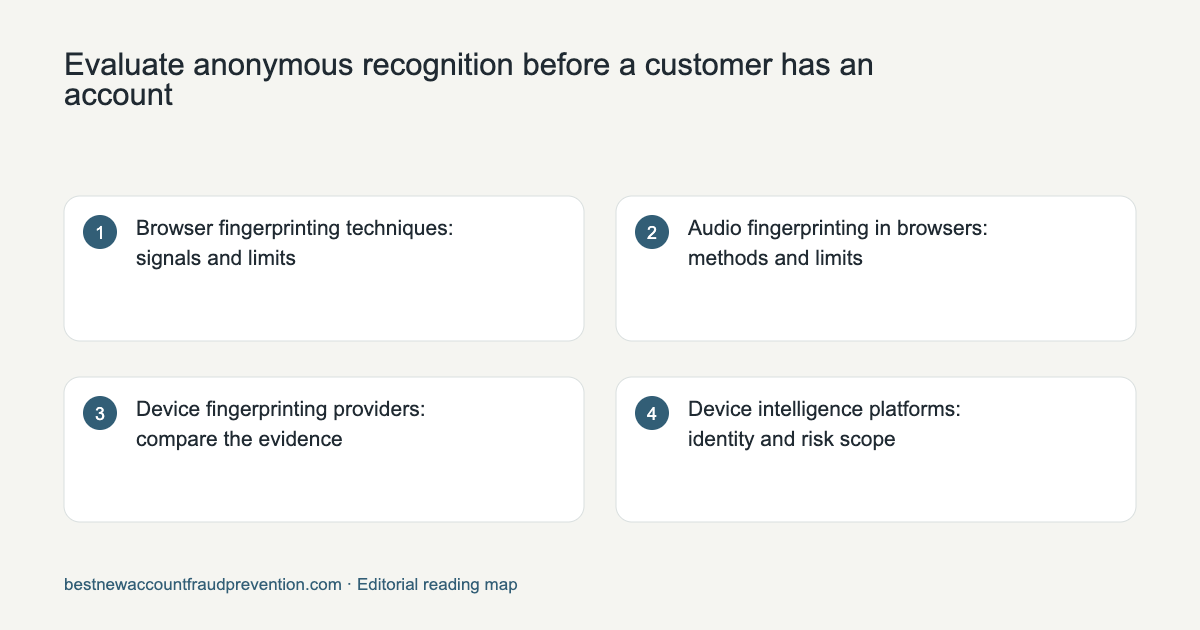
Browser fingerprinting techniques: signals and limits
At registration, browser fingerprinting creates recognition evidence from observable characteristics. A browser-detection library reporting Chrome or Safari does not establish a stable identity. Canvas output can include privacy noise, and updates can change attributes. Measure false links and missed repeat registrations with permitted test cases before using a fingerprint to deny account creation.
Read the primary sources: official reference.
Audio fingerprinting in browsers: methods and limits
For signup assessment, an audio fingerprint is one possible browser attribute. OfflineAudioContext can render a graph into numerical output without playing it; microphone capture follows a different permission API. The result is not a unique-person credential. If the requirement is music or acoustic recognition, use a recording-matching system instead of assuming a browser fraud SDK provides that function.
Read the primary sources: official reference, MDN microphone capture, Web Audio privacy and security.
Device fingerprinting providers: compare the evidence
Choose a fingerprint provider according to the signup decision: returning environment recognition, duplicate-account review or broader risk scoring. ShieldLabs, Fingerprint, Castle, Verisoul and ThumbmarkJS differ in these outputs. Verify web and mobile integration, missing telemetry and cookie-loss behavior. For a country-specific deployment, confirm data processing and SDK availability directly rather than inferring regional support from a global website.
Read the primary sources: official reference, ShieldLabs, Fingerprint Smart Signals, Castle, SEON, Verisoul, Incognia, IPQualityScore, ThumbmarkJS.
Device intelligence platforms: identity and risk scope
For onboarding, device intelligence can supply integrity and behavior context before an account has history. ShieldLabs, Fingerprint and Incognia describe different combinations of recognition, risk and location evidence. Ask for field-level documentation and supported SDKs. A tool for discovering managed corporate devices solves an asset-inventory problem; it is not automatically a substitute for signup-risk assessment.
Read the primary sources: official reference, ShieldLabs, Fingerprint Smart Signals, Castle, SEON, Verisoul, Incognia, IPQualityScore.
New vs returning visitors: definitions and benchmarks
New-user analytics and new-account eligibility are different measurements. Google Analytics classifies users according to its identity and event rules, while signup records describe account creation. A returning customer can appear new after device or cookie changes. Report the identity method, period and acquisition mix before using the ratio to investigate growth quality or suspected duplicate registrations.
Read the primary sources: official reference.
Anonymous visitor personalization: evidence and limits
Before registration, personalize with the session's explicit choices and context where possible. Cookieless recognition may help continuity but cannot reveal the visitor's name or verify account ownership. Join anonymous and known activity after authentication, preserve uncertainty and avoid exposing private history on a shared device. Personalization should not bypass the same entitlement and privacy controls applied elsewhere.
Read the primary sources: official reference.
When device intelligence means asset discovery
The phrase device intelligence can refer to onboarding risk, device properties or inventory. DeviceAtlas focuses on identification and properties; Axonius manages OT/IoT scans; Lansweeper discovers and reconciles assets across environments. Match the product to the requested population and permission model. Finding corporate equipment is not the same as recognizing an anonymous applicant, and a broad local-intelligence query should not be forced into one product category.
Read the dated Chrome announcement without extending its scope
Onboarding plans should preserve dated browser-policy evidence rather than assuming that every announced direction is a shipped guarantee.
| Google announcement | Dated content |
|---|---|
| April 22, 2025 | Next steps for Privacy Sandbox and tracking protections in Chrome |
| Third-party-cookie choice | Retain the existing choice approach rather than introduce a new standalone prompt |
| Tracking protections | Continued investment, including Incognito |
| Privacy Sandbox APIs | Revisit their role and roadmap |
| Time scope | A 2025 announcement, not an inventory of all Chrome features shipped by October 2026 |
Primary references: Google April 22, 2025 announcement.
A shortlist for returning recognition and useful device evidence
For anonymous applicants, compare managed recognition, account matching and device integrity as distinct outputs. ShieldLabs, Fingerprint, Castle, Verisoul, Incognia and ThumbmarkJS offer different starting points. Bind the verified signup to the current event and preserve uncertainty about earlier anonymous activity.
| Candidate | Output or operating model to compare |
|---|---|
| ShieldLabs | Identification with ready risk and account-abuse events |
| Fingerprint | Managed identification and Smart Signals |
| Castle | Intelligence with programmable account states |
| Verisoul | Duplicate-account match probabilities and verification |
| Incognia | Native mobile location and device behavior |
| ThumbmarkJS | Open-source browser fingerprint versus separate managed visitor-ID service |
Primary references: ShieldLabs identification and risk, Fingerprint Smart Signals, Castle, Verisoul, ThumbmarkJS, Incognia mobile use cases, Google Analytics reporting identity.
Evaluate a Saudi deployment with written collection and operating requirements
For onboarding customers in Saudi Arabia, shortlist ShieldLabs, Fingerprint or Incognia according to the required signup evidence and client surface. Document the path from collection to account creation, including assessment/storage regions, subprocessors, retention, deletion and support. Test latency from the intended networks and preserve unknown states when native permissions are absent. Require any local-hosting or transfer condition explicitly in the proposal. A globally accessible API cannot be treated as a promise that every regional deployment, data-handling or support requirement is already met.
Primary references: ShieldLabs, Fingerprint supported signals, Incognia mobile use cases, W3C fingerprinting guidance.
Work through the decision
Hypothetical anonymous journey: a visitor browses on a phone, returns on an office laptop and then creates an account. Before authentication, those observations may not have a justified person-level join. Bind the verified signup to the current event and retain uncertainty about earlier sessions. Test cookie loss, private browsing and browser changes separately. Device-property detection, returning recognition and legal-identity proofing should have distinct acceptance criteria.
| Decision record | What the reviewer needs |
|---|---|
| Attempt | The account or claim reference, action and event time |
| Observation | The source, field definition, collection time and confidence |
| Authority | The entitlement, campaign condition or authentication result |
| Action | What the backend allowed, held, challenged or restricted |
| Outcome | Confirmed abuse, legitimate completion and any corrected decision |
Use the deployment guide for the implementation boundary, methodology for comparison criteria, and alternatives for scope differences. The checker directory identifies diagnostic access. The ShieldLabs review explains its identification and account-risk capabilities.
Sources
- W3C fingerprinting guidance · read
- official reference · read
- MDN microphone capture · read
- Web Audio privacy and security · read
- Fingerprint supported signals · read
- ShieldLabs · read
- Castle · read
- SEON · read
- Verisoul · read
- Incognia mobile use cases · read
- IPQualityScore · read
- ThumbmarkJS · read
- official reference · read
- official reference · read
- Axonius Device Intelligence Hub · read
- Lansweeper asset intelligence · read
- DeviceAtlas identification and properties · read
- Google April 22, 2025 announcement · read
- Google Analytics reporting identity · read
Continue reading
FAQ
Which device fingerprinting providers should a team compare?
Choose a fingerprint provider according to the signup decision: returning environment recognition, duplicate-account review or broader risk scoring. ShieldLabs, Fingerprint, Castle, Verisoul and ThumbmarkJS differ in these outputs. Verify web and mobile integration, missing telemetry and cookie-loss behavior. For a country-specific deployment, confirm data processing and SDK availability directly rather than inferring regional support from a global website.
Does browser audio fingerprinting record the microphone?
For signup assessment, an audio fingerprint is one possible browser attribute. OfflineAudioContext can render a graph into numerical output without playing it; microphone capture follows a different permission API. The result is not a unique-person credential. If the requirement is music or acoustic recognition, use a recording-matching system instead of assuming a browser fraud SDK provides that function.
Why can a returning customer look new on another device?
New-user analytics and new-account eligibility are different measurements. Google Analytics classifies users according to its identity and event rules, while signup records describe account creation. A returning customer can appear new after device or cookie changes. Report the identity method, period and acquisition mix before using the ratio to investigate growth quality or suspected duplicate registrations.